
October Newsletter: A Busy Term for CAC at the Supreme Court
This week, the Supreme Court’s new Term began, and the Court isn’t wasting any time before digging into incredibly important issues. CAC has filed in many of the big cases the Court will be hearing at the beginning of this Term.
On Monday, in Villarreal v. Texas, the Court considered whether a defendant’s right to counsel was violated when he was prohibited from discussing his own testimony with his attorney at a critical point in his trial. Our amicus brief explained why his Sixth Amendment rights were violated. As CAC Appellate Counsel Ana Builes explained after listening to oral argument in the case, “By prohibiting Mr. Villarreal from consulting with his counsel about important aspects of his case at a critical stage of his trial, the Texas trial court denied him his counsel’s assistance when he needed it the most and denied him the fair trial that the Sixth Amendment guarantees.”
And on Tuesday, in Chiles v. Salazar, the Court considered whether Colorado can prohibit licensed mental health professionals from practicing “conversion therapy” on young people, given the consensus in the medical community that this practice is deeply harmful. Our amicus brief explained that it does not violate the First Amendment for states to protect their residents from such dangerous practices. As CAC’s Vice President Praveen Fernandes wrote after oral argument, “The Court has long acknowledged states’ power to shield their residents from ineffectual or harmful practices by state-licensed professionals.”
Next week, the Court will hear Ellingburg v. United States. Though the Constitution’s Ex Post Facto Clause prohibits Congress from retroactively making a punishment more severe, Holsey Ellingburg was told he must pay nearly double the amount of restitution he was assigned at his sentencing, solely due to changes in the law after his crime occurred. Our brief explains why the Ex Post Facto Clause applies to the restitution law Congress passed after Mr. Ellingburg’s crime.
And on October 15, the Court is hearing Louisiana v. Callais, a case with high stakes for the future of the Voting Rights Act. Our amicus brief explains that the Constitution gives Congress broad enforcement power to prevent impairment of the right to vote, including through the protections of the Voting Rights Act. As CAC’s David H. Gans explained in Slate magazine, drawing on his exciting new research on Black advocacy for voting rights in the aftermath of the Civil War, this ought to be an “open-and-shut” case if the Roberts court is faithful to constitutional text and history. Also on October 15, the Court is considering whether police may enter homes without warrants based on less than probable cause that an emergency is occurring. Our amicus brief details why allowing such entries would be at odds with the Fourth Amendment’s text and history.
Looking ahead, CAC has also already filed several amicus briefs in cases the Supreme Court will be hearing in November. When Damon Landor, a devout Rastafarian who wore his hair in dreadlocks in accordance with his religion, showed prison officials a printout of a court decision holding that the law protected his right to keep his dreadlocks in prison, the officials threw the decision into the trash, held him down, and shaved his head. When he sued the prison employees for violating his rights, the lower courts held that the law protecting the religious freedom of incarcerated people does not provide for damages against individual state officials. Our amicus brief explains that the law protected Landor’s ability to vindicate his rights.
On November 12, the Court will consider two cases about the scope of a sentencing judge’s discretion to grant compassionate release under the Sentencing Reform Act. In Rutherford v. United States and Carter v. United States, the Court is considering whether a judge can grant reductions in a petitioner’s sentence under the Sentencing Reform Act because of a significant difference between the sentence they are serving and the sentence that they would have received if they were sentenced for those same offenses today. Our amicus brief explains that judges should be allowed to consider major changes in the law that result in sentencing disparities solely based on when a person was sentenced. And in Fernandez v. United States, our amicus brief explains that a judge should be allowed to consider his “disquiet” about the validity of the jury’s verdict in granting compassionate release.
Needless to say, things have been very busy here at CAC. Even as we continue to support legal challenges to unlawful actions taken by the Trump administration, we’re also still fighting for our Constitution’s progressive promise at the Supreme Court.

- San Francisco v. Trump— The District Court for the Northern District of California is considering whether the Trump administration can unilaterally withhold federal funds from jurisdictions that decline to implement his immigration agenda. CAC filed a brief in support of the plaintiffs, urging the court to deny the pending motion to dismiss. Our brief explains why the administration’s actions are a violation of separation-of-powers principles, and that Supreme Court precedent allows the constitutional claims at issue to be reviewed by the courts. Northern California District Court, brief filed October 7.
- National Republican Senatorial Committee v. Federal Election Commission — The Supreme Court is considering whether to strike down a law that limits the amount of money a national political party committee may spend in coordination with federal candidates for elected office. CAC filed an amicus brief asking the court to uphold the law’s coordinated party expenditure limits, explaining that the law is narrowly tailored to target corruption concerns dating back to the Founders, and that Supreme Court precedent permits contributions limits such as those considered here. Supreme Court, brief filed October 6.
- National Treasury Employees Union v. Vought — The D.C. Circuit is considering whether to rehear en banc the case regarding the Trump administration’s efforts to unilaterally shut down the Consumer Financial Protection Bureau. Our amicus brief explains why the administration’s actions violate the Constitution’s separation of powers, and why the constitutional claim at issue is judicially reviewable under Supreme Court precedent. C. Circuit, brief filed September 30.
- PFLAG v. Trump — The Fourth Circuit is considering whether President Trump can legally cut off federal funding for institutions that provide gender-affirming medical care for people under the age of nineteen. CAC filed a brief explaining why constitutional history, centuries of executive practice and court precedent, and separation-of-powers principles prohibit the President from usurping Congress’s power of the purse in an attempt to achieve his own policy initiatives. Fourth Circuit, brief filed September 26.
- RAICES v. Noem — The D.C. Circuit is considering whether the Trump administration’s efforts to prohibit certain people in the country from seeking asylum is lawful. CAC filed an amicus brief explaining that the law does not allow the government to “repatriate” asylum-seekers that are already within the country, and that the administration’s actions would upend the asylum system Congress established. C. Circuit, brief filed September 19.
- Novartis v. Secretary United States Department of Health and Human Services — WIN — The Third Circuit upheld the constitutionality of the Medicare prescription drug price negotiation program at issue in this case, rejecting Novartis’s constitutional arguments, including its Takings Clause argument. Echoing our brief and citing the court’s earlier ruling in Bristol Myers Squibb v. Becerra, the court emphasized the voluntary nature of the government’s program and concluded that there is no physical taking. Third Circuit, decision rendered September 11.
- Parada v. United States — The Supreme Court is being asked to consider whether the Sixth Amendment requires a 12-person jury for a felony conviction. After being convicted by a jury of only eleven people, the petitioners are asking the Court to hear their case and reconsider precedent that allows such a conviction. CAC filed a brief in support of the petitioners, explaining that at the Founding and throughout common law, juries were understood to consist of twelve people. We argue that the prior case that allowed such small juries improperly dismissed the history of the Sixth Amendment. Supreme Court, brief filed September 11.
- Properties of the Villages, Inc. v. Federal Trade Commission — After the change in presidential administrations, the FTC moved to voluntarily dismiss the appeal, acceding to the vacatur of the noncompete rule at issue in the case. Eleventh Circuit, case dismissed September 10.
- C. v. Metropolitan School District of Martinsville — The Seventh Circuit is considering whether the Supreme Court’s recent decision in United States v. Skrmetti requires it to overrule previous decisions recognizing that schools that prohibit students from using bathrooms consistent with their gender identity are discriminating on the basis of sex in violation of Title IX. CAC filed a brief in support of a transgender boy whose school had such a policy, explaining that the Court’s decision in Skrmetti—a case involving gender-affirming medical care for transgender minors—should have no effect on precedent regarding gender-aligned bathroom use. Seventh Circuit, brief filed September 10.
- Newsom v. Trump — The Ninth Circuit is considering the legality of Trump’s deployment of the National Guard in Los Angeles in response to mostly peaceful protests. CAC filed a brief explaining that, contrary to the Trump administration’s arguments, Supreme Court precedent does not prohibit courts from reviewing presidential decisions to federalize the National Guard, and that founding-era history demonstrates that judges may appropriately evaluate whether the necessary factual conditions exist to justify such action. Ninth Circuit, brief filed September 9.
- Ortega v. Office of the Comptroller of the Currency — WIN — The Fifth Circuit denied the petition for review and dismissed the Seventh Amendment claim against the OCC. Echoing our brief, the court detailed the history of the national banking system and explained that “such a serious and unbroken historical pedigree” proves that “the public-rights exception applies to federal banking enforcement actions, and that petitioners had no right to a jury trial in this matter.” Fifth Circuit, decision rendered September 8.

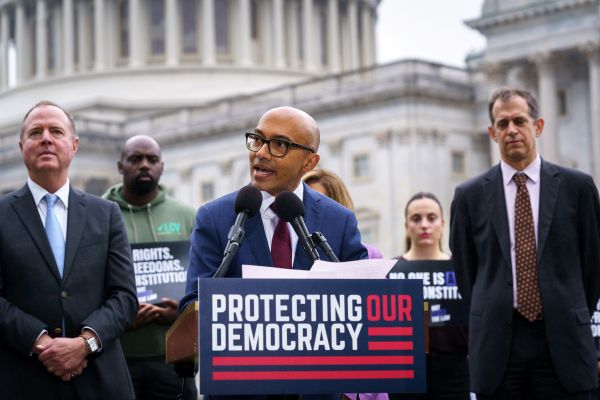
- September 17: CAC Vice President Praveen Fernandes spoke at a Not Above the Law press conference on Capitol Hill in recognition of Constitution Day. “Constitution Day Press Conference Livestream”
- October 7: Professor Rick Hasen’s Election Law Blog featured David Gans’s piece in Slate. “Election Law Blog: “The Supreme Court Is Being Tested on History Once Again””
- October 7: The New Civil Rights Movement quoted CAC in their article covering oral arguments in Chiles v. Salazar at the Supreme Court. “Supreme Court Appears Poised to Strike Down Ban on Anti-LGBTQ ‘Conversion Therapy’”
- October 7: David Gans published a piece in Slate on the history behind the Fourteenth and Fifteenth Amendments and the Voting Rights Act. “The Supreme Court Is Being Tested on History Once Again”
- October 6: Praveen Fernandes was quoted in an article from Bloomberg Law on the First Amendment questions at issue in Chiles v. Salazar. “Conversion Therapy Ban Case Tests Traditional State Police Power”
- September 28: Writing for The Guardian, Leah Litman cited CAC’s brief in Allen v. Milligan and Allen v. Caster as part of her discussion of the history of the Voting Rights Act. “A 160-year-old campaign against civil rights heads to the supreme court”
- September 26: An opinion piece in the Boston Globe noted CAC in its discussion of organizations that are taking action through amicus work at the Supreme Court. “Your SCOTUS questions, answered!”
- September 23: David Gans was quoted in a piece in Stateline on cashless bail. “Cashless bail, explained: What it is, how it works and why Trump is targeting it”
- September 22: NBC News quoted Elizabeth Wydra in an article covering the Trump administration’s success on the Supreme Court’s shadow docket. “White House bullish after a long string of Supreme Court victories”
- September 19: CAC signed onto an open letter calling for an end to the attacks on nonprofit organizations by the Trump administration. “Open Letter: Stand Together Against Trump’s Threats to Non-Profit Organizations”
- September 16: Praveen Fernandes published a piece on the American Constitution Society’s blog in honor of Constitution and Citizenship Day. “We Celebrate the Constitution and Citizenship at a Time When Both Are Under Attack”
- September 14: David Gans’s appearance on the Circumscription podcastwas featured in Professor Rick Hasen’s Election Law Blog. “David Gans on Circumscription Podcast Talking about Louisiana v. Callais, and Voting Rights at the Supreme Court”
- September 9: CAC’s brief in Ortega v. OCC was cited in an article from Vital Law covering the decision in the case. “ENFORCEMENT ACTIONS—Fifth Circuit rejects petition challenging OCC authority to enforce national banking rules”

A Warm Welcome to Our Newest Team Members, and Farewell to Our Outgoing Fellows!
CAC is pleased to announce that Michelle Berger is the 2025-2026 Douglas T. Kendall Fellow at the Constitutional Accountability Center. Michelle brings years of advocacy in the labor rights and tenants’ rights movements, and has previously clerked for the U.S. District Court for the Western District of Michigan. Michelle has worked with Public Citizen, the United States Department of Labor’s Office of the Solicitor, and the National Labor Relations Board. We were sad to say goodbye to 2024-2025 Kendall Fellow Nargis Aslami, who reflected on her year at CAC on our blog, but are excited for Nargis’s next chapter.
CAC is also delighted to welcome former CAC intern Simon Chin back as a Legal Fellow. In addition to his previous time with CAC, Simon previously served as a law clerk on the U.S. Court of Appeals for the Second Circuit and the Southern District of New York. He also worked as an associate in the Supreme Court and appellate practice of Hogan Lovells. We are also happy to welcome back former CAC intern Harith Khawaja as a Legal Fellow. In addition to his Supreme Court advocacy and work on behalf of immigrant rights during law school, Harith previously worked with the Institute for Constitutional Advocacy and Protection. Before law school, Harith worked for three years as a software engineer. CAC is excited to have Simon and Harith back on the team!
YOUR Support Directly Enables CAC to Fulfill Our Progressive Constitutional Mission
CAC’s work helps defend the rule of law, advance economic justice, promote civil and human rights, and much more. In this critical year, will you support CAC with a gift of $50, $100, $500 or more to fulfill the Constitution’s progressive promise?