
July 2025 Newsletter: A Troubling Term for Individual Rights at the Supreme Court
Last month, the Supreme Court concluded an eventful term, issuing major decisions on both its merits and shadow docket. As CAC President Elizabeth Wydra explained on C-SPAN’s Washington Journal and Bloomberg TV, those major decisions included multiple decisions in which the Court’s conservative supermajority limited individual rights, making this a very “concerning” chapter in the Court’s history.
To start, the Court’s decision that federal courts cannot issue universal injunctions blocking unconstitutional actions on a nationwide basis unless such injunctions are necessary to afford the plaintiffs “complete relief” will create enormous barriers to justice. It is particularly troubling that the Court used the birthright citizenship case as the vehicle for this decision, given that, as our brief filed on behalf of an ideologically diverse group of legal scholars explained, constitutional text and history make abundantly clear that President Trump’s birthright citizenship executive order is unconstitutional. As CAC Senior Appellate Counsel Smita Ghosh stated, “This decision will affect litigants across ideological lines, applying equally to challengers to gun control or immigration policies. But it is painfully ironic, and deeply concerning, that the Court issued this decision in the face of a policy that undercuts the deeply cherished constitutional guarantee of birthright citizenship and is widely understood to be unconstitutional.” CAC Equal Justice Works Fellow Anna Jessurun explained in Courthouse News that while litigants can continue to pursue broader relief through class action lawsuits, “It’s just an extra hurdle for plaintiffs seeking to create broad relief that impacts not just the individuals who filed the case, but other similarly situated individuals across the country.”
In Skrmetti v. United States, the Court applied rational basis review to Tennessee’s ban on gender-affirming medical care for transgender adolescents and upheld the ban, even though, as our brief explained, this ban plainly discriminates on the basis of sex, making heightened scrutiny appropriate. CAC Vice President Praveen Fernandes highlighted the damage this decision will do, explaining, “In addition to the unfathomable and cruel human harms this decision will cause, the majority should not lose sight of the damage it also will do to the Court, undermining its reputation as an institution able to serve as a bulwark against sex discrimination.” And in Stanley v. City of Sanford, the Court gutted the Americans with Disabilities Act’s protections for retirees. CAC Senior Appellate Counsel Miriam Becker-Cohen stated that interpreting the ADA to allow employers to engage in post-employment discrimination “makes little sense, sharply limits relief for people with disabilities, and is at odds with the proper approach to statutory interpretation.”
The Court also issued several other important decisions on due process and access-to-justice issues, with mixed results. The Court delivered a narrow, unanimous win for victims of a wrong-house raid. It also rejected a Fifth Circuit ruling that would have made it more difficult to pursue procedural due process claims, allowing a death-row prisoner to present an argument that he had been improperly denied DNA testing. Unfortunately, the Court also made it more difficult for non-citizens facing deportation to bring Convention Against Torture claims, interpreting statutory deadlines in a way that could make it much more difficult to challenge some deportation decisions.
As this Supreme Court term ends, we’ve already begun filing briefs in cases the Court will be hearing next term, and of course, the Supreme Court is just one of many fronts where CAC is using text-and-history arguments to support progressive outcomes. In W.M.M. v. Trump, CAC filed an amicus brief in the Fifth Circuit explaining why President Trump cannot use the Alien Enemies Act to send Venezuelan immigrants to a Salvadoran prison notorious for human rights abuses. As CAC Appellate Counsel Ana Builes explained on our blog, “It is emphatically the role of courts to interpret the text of statutes like the Alien Enemies Act and decide whether Tren de Aragua qualifies as a ‘nation or government’ within the meaning of that text. It clearly does not.” And in the District of Maryland, CAC filed a brief on behalf of Members of Congress arguing that Trump cannot unilaterally dismantle the Department of Education. As Senator Elizabeth Warren told ABC News, “Donald Trump is not a king, and he cannot single-handedly cut off access to education for students across this country.”
Though this chapter at the Supreme Court was deeply disappointing, CAC won’t stop fighting—at the high court and in other courts around the country.

- NAACP v. United States — The District of Maryland is considering whether the Trump administration’s unilateral dismantling of the Department of Education violates federal law and the Constitution. CAC filed a brief on behalf of Members of Congress urging the court to grant the plaintiffs’ motion for a preliminary injunction to block the administration’s efforts. We explain that Congress has the sole authority to restructure or abolish federal departments and agencies, and because the Department is a statutorily mandated agency, the President does not have the power to abolish it unilaterally. District of Maryland, brief filed July 3.
- Ellingburg v. United States — Next term, the Supreme Court will consider whether the Ex Post Facto Clause applies to restitution ordered under a federal law called the Mandatory Victims Restitution Act (MVRA). Our brief explains that restitution has been used as a criminal punishment for thousands of years, and the text and structure of the MVRA both reflect Congress’s intent to draw on this history and use restitution to punish and rehabilitate defendants and deter future potential offenders—in other words, to use it as a criminal penalty. Because the MVRA uses restitution as a punishment for a crime, the Ex Post Facto Clause applies. Supreme Court, brief filed June 30.
- Federal Communications Commission v. Consumers’ Research — WIN — The Supreme Court ruled in favor of the FCC and held that its statutory mandate to make internet access more affordable does not violate the nondelegation doctrine. The Court’s opinion explained that the authority delegated by Congress to the FCC was “sufficiently guided and constrained,” and that the FCC appropriately “retained all decision-making authority within that sphere.” Supreme Court, decision rendered June 27.
- Trump v. CASA, Trump v. Washington, and Trump v. New Jersey — The Supreme Court held that universal injunctions likely exceed the authority Congress has granted the federal courts except when such injunctions are necessary to provide the plaintiffs “complete relief.” Accordingly, the Court partially stayed the lower courts’ injunctions on Trump’s executive order limiting the constitutional guarantee of birthright citizenship. Justice Sotomayor, joined by Justices Kagan and Jackson, dissented, noting that the majority “renders constitutional guarantees meaningful in name only” to anyone not directly party to a lawsuit. She also observed that the majority ignored the content of the executive order, which she explained is “patently unconstitutional,” echoing arguments made in the brief we filed on behalf of an ideologically diverse group of leading scholars of constitutional law and immigration. Supreme Court, decision rendered June 27.
- Riley v. Bondi — The Supreme Court held that noncitizens in deportation proceedings need to seek review of Final Administrative Removal Orders, even when they have Convention Against Torture claims still pending. The Court also concluded, as we argued in our brief, that the relevant statute’s filing deadline is a claims-processing rule, not a jurisdictional requirement. Therefore, notwithstanding the majority’s decision on FAROs, Pierre Riley’s case can proceed on remand. Supreme Court, decision rendered June 26.
- Gutierrez v. Saenz — The Supreme Court ruled in favor of Gutierrez, holding that the death-row prisoner has standing to challenge Texas’s DNA testing procedures under the Due Process Clause. Rejecting the Fifth Circuit’s decision, and echoing our brief, the Court emphasized that access to courts to pursue such a claim does not require plaintiffs to demonstrate certain success with respect to retaining their underlying protected interests. Supreme Court, decision rendered June 26.
- Stanley v. City of Sanford — In a splintered opinion, the Supreme Court ruled against retired firefighter Lt. Karyn Stanley and concluded that the “qualified individual” language under Title I of the Americans with Disabilities Act does not protect individuals who face disability-based discrimination regarding their benefits after they retire. Echoing our brief, Justice Jackson’s dissent explained that the ADA’s history “helps us to understand” the statute’s text and makes clear that the law does not allow disability discrimination before or after retirement. Supreme Court, decision rendered June 20.
- Community Legal Services in East Palo Alto v. HHS — The Ninth Circuit is considering whether to stay a district court decision that prevented the Office of Refugee Resettlement from cutting off funding for legal services for unaccompanied children in immigration proceedings. CAC filed an amicus brief in support of the legal aid groups bringing the case, explaining that the language of the relevant legislation, as well as congressional appropriations since its passage, make clear that ORR’s funding-cutting actions are unlawful. Ninth Circuit, brief filed June 20.
- United States v. Skrmetti — The Supreme Court upheld the Tennessee law banning gender-affirming medical care for transgender adolescents. The Court concluded that the law does not rely on sex-based classifications and is thus not subject to heightened scrutiny, and that it satisfies rational basis review. Justice Sotomayor, joined by Justice Jackson in full and Justice Kagan in part, dissented, finding that the law “expressly classifies on the basis of sex and transgender status” and therefore necessitates heightened review under intermediate scrutiny. Under such a standard, the dissent concluded that there is “reason to question” whether the law is constitutional. Supreme Court, decision rendered June 18.
- AIDS Vaccine Advocacy Coalition v. Department of State and Global Health Council v. Trump — The D.C. Circuit Court of Appeals is considering whether the Trump administration’s unilateral decision to freeze funding to foreign development assistance programs violates federal law and the Constitution. CAC filed a brief in support of plaintiffs, reiterating the argument we made in the brief we filed in the district court and explaining that neither the Impoundment Control Act nor the President’s foreign affairs powers authorize him to defy the will of Congress by refusing to execute duly enacted laws. C. Circuit, brief filed June 13.
- Martin v. United States — WIN — The Supreme Court rejected the Eleventh Circuit’s “outlier position” that the Supremacy Clause supplied the government with a defense to liability in this case in which officers were sued under the Federal Tort Claims Act for mistakenly raiding the wrong person’s home. As we argued in our brief, the Supremacy Clause serves as a rule of decision for courts to apply only in places where a conflict exists between state and federal law. Supreme Court, decision rendered June 12.

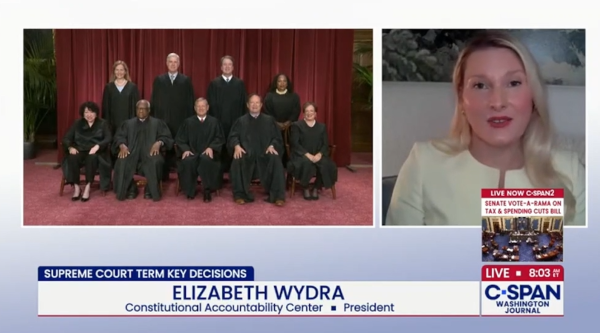
- July 1: Elizabeth Wydra appeared on C-SPAN to reflect on the Supreme Court’s 2024-25 term. “TV (C-SPAN): Elizabeth Wydra and John Malcolm on Key Supreme Court Decisions”
- July 3: ABC News covered CAC’s brief on behalf of Members of Congress in the case on the attempted dismantling of the Department of Education. “175+ Democrats supporting NAACP suit against dismantling Department of Education”
- July 1: CAC’s brief was quoted in Law360’s article on the Supreme Court’s decision in Gutierrez v. Saenz. “Compounding Restitution Is Unconstitutional, High Court Told”
- June 28: Elizabeth Wydra appeared on Fox News to discuss the implications of the Supreme Court’s birthright citizenship ruling in Trump v. CASA. “TV (Fox News): SCOTUS limits nationwide injunctions with ‘extremely significant’ birthright decision”
- June 28: The Washington Post quoted Smita Ghosh on the impact of the Court’s nationwide injunction decision. “Trump says he will move aggressively to undo nationwide blocks on his agenda”
- June 27: Elizabeth Wydra joined Bloomberg’s Balance of Power to discuss the Supreme Court’s ruling on nationwide injunctions. “TV (Bloomberg): ‘Serious Concern:’ Wydra on SCOTUS Injunction Ruling”
- June 27: Anna Jessurun was quoted in Courthouse News’ article on the shift toward class actions after the Supreme Court ruling on universal injunctions. “With universal injunctions out of style, class actions are already trending”
- June 26: Courthouse News quoted Miriam Becker-Cohen in its article on the Supreme Court’s decision in Gutierrez v. Saenz. “Texas decades-old DNA testing fight falls short at SCOTUS”
- June 11: Praveen Fernandes was quoted in Common Dreams’ article on the Not Above the Law coalition’s response to the indictment of Representative McIver. “‘None of Us Knows Who Will Be Next,’ Pro-Democracy Coalition Says After McIver Indictment”

Farewells at CAC
This past month, our inaugural Scholar-in-Residence, Professor Alexis Hoag-Fordjour, concluded her year with CAC. We are so grateful to Professor Hoag-Fordjour for her time and scholarship at CAC.
CAC is also saying goodbye to our Operations Manager, Olurotimi Odewole, who is beginning law school at Howard University in the fall. Congratulations to Olurotimi for beginning this next chapter!
YOUR Support Directly Enables CAC to Fulfill Our Progressive Constitutional Mission
CAC’s work helps defend the rule of law, advance economic justice, promote civil and human rights, and much more. In this critical year, will you support CAC with a gift of $50, $100, $500 or more to fulfill the Constitution’s progressive promise?