
August 2025 Newsletter: Another Year of Big Wins for Corporate Interests at the Supreme Court

For years, the Constitutional Accountability Center has tracked the success of big business at the Supreme Court, using the success of the Chamber of Commerce as a proxy for corporate interests. As CAC’s Brian Frazelle and Ana Builes recently wrote in Slate, the Court “has adopted the position advocated by the U.S. Chamber of Commerce in nearly 70 percent of its cases since John Roberts became chief justice 20 years ago. Some terms, the Roberts court has sided with the Chamber 80 percent, 90 percent, and even 100 percent of the time. That is a sharp increase from prior decades, when the Chamber’s success rate hovered around 50 percent.” And this Term was no exception, as our most recent report found that the Supreme Court is continuing to favor corporations over workers, consumers, and the environment.
The success of big business at the Court has become so notable that even some of the Court’s own members have begun to comment on it. As Justice Jackson noted in a recent dissent, “moneyed interests” seem to “enjoy an easier road to relief in this Court than ordinary citizens.” And as Justice Sotomayor remarked in a dissent from a decision that could make it more difficult for some immigrants to raise claims that they will be tortured if returned to their countries of origin, the Roberts Court’s conservative majority has a trend of subjecting “politically disfavored” litigants like immigrants to “illogic” and bureaucratic traps while bending over backwards to ensure that regulated businesses do not get treated unfairly. Indeed, multiple decisions this Term limited access to justice, making it harder to seek relief under the Americans with Disabilities Act and limiting attorney’s fees for successful civil rights plaintiffs.
Brian and Ana’s Slate piece also explained that the success of big business is evident not only in the Court’s decisions, but even in the cases the Court decides to hear. “Overwhelmingly, the justices choose to review lower-court decisions that go against corporate interests—rarely the opposite. In some recent terms, over 90 percent of the business cases the court chose to hear were corporate challenges to lower-court rulings that favored individuals or the government over industry. By stacking the deck this way, the court gives big business plenty of opportunities to overturn unfavorable decisions, while avoiding putting corporate victories in jeopardy.”
As the next Term at the Supreme Court takes shape, CAC will keep fighting to try to ensure that everyone enjoys the Constitution’s protections, not just the rich and powerful.

- Fernandez v. United States — The Supreme Court is considering the scope of a sentencing judge’s discretion to grant compassionate release under the Sentencing Reform Act. After a district court judge exercised his discretionary authority by reducing a life sentence in a case about which he harbored “disquiet” over the verdict, the Second Circuit reversed the decision to grant compassionate release. CAC filed an amicus brief urging the Court to reverse the Second Circuit’s decision, explaining that it goes against the text and history of the compassionate release statute, which permits “extraordinary and compelling reasons” to justify a sentence reduction. Supreme Court, brief filed August 11.
- Villarreal v. Alaniz — The Supreme Court again is being asked to consider whether the Fifth Circuit erred in granting qualified immunity to officials who arrested and prosecuted a journalist simply for asking a police officer a question. After the case was remanded to the Fifth Circuit, Villarreal filed a new petition to the Court, and CAC again filed a brief in support of the petition that urged the Court to summarily reverse the Fifth Circuit’s ruling. Our brief explains that 42 U.S.C. § 1983 was enacted, in part, to make real the First Amendment’s promise to protect the speech of all people, even those who criticize authorities. Supreme Court, brief filed August 8.
- Grant v. Knapp — The Fourth Circuit is considering whether a South Carolina law that only allows voters who are 65 and older to vote by mail without a qualifying excuse violates the Twenty-Sixth Amendment’s prohibition on age-based discrimination in voting. CAC’s brief in support of the voters explains that the lower court erred in relying on Fourteenth Amendment precedent to guide its interpretation of the Twenty-Sixth Amendment, and that the text and history of the Twenty-Sixth Amendment broadly forbids discrimination in voting based on age. Fourth Circuit, brief filed August 6.
- Case v. Montana — The Supreme Court is considering whether police may enter homes without warrants based on less than probable cause that an emergency is occurring. After police entered William Case’s home without a warrant based on a report that he might harm himself, they shot him. The Montana Supreme Court concluded the warrantless entry was legal because the police needed only “reasonable suspicion” to enter. Case appealed the decision to the Supreme Court, and CAC filed a brief in support of Case, explaining that using a standard below probable cause to allow warrantless home entries would be contrary to the text and history of the Fourth Amendment. Supreme Court, brief filed August 6.
- United States v. Paxton — The Fifth Circuit reversed the lower court’s decision, concluding that Texas’s ID number requirement complies with the Materiality Provision in the Civil Rights Act of 1964 because the number is “plainly material” to assessing a voter’s qualification to vote. Fifth Circuit, decision rendered August 4.
- American Foreign Service Association v. Trump — The district court concluded that it lacked subject-matter jurisdiction over the plaintiffs’ claims and therefore did not address the merits of their allegations regarding the dismantling of USAID that were addressed in our brief. Accordingly, the court granted the government’s motion to dismiss the case. C. District Court, decision rendered July 25.
- New York v. Trump — The First Circuit is considering whether the Trump administration’s unilateral and categorical decision to freeze all federal funding to programs that do not align with its policy priorities violates federal law and the Constitution. After the court denied the request to stay the order restoring funding to critical programs, it is now considering the merits of the case. CAC has filed another amicus brief at the court in support of the states, explaining why separation-of-powers principles bar the President from usurping Congress’s power of the purse. First Circuit, brief filed July 25.
- Cultivate KC v. Department of Agriculture — The District Court of D.C. is considering whether the Trump administration’s unilateral decision to terminate grants to farmers and agricultural nonprofits funded under the Inflation Reduction Act violates federal law and the Constitution. CAC filed an amicus brief in support of Plaintiffs, explaining that constitutional history and legislation, as well as centuries of executive practice and court precedent, prohibit this violation of separation-of-powers principles. C. District Court, brief filed July 24.
- Washington v. Trump — WIN — The Ninth Circuit held that the Trump administration’s Executive Order attempting to revoke birthright citizenship is unconstitutional under the Fourteenth Amendment’s Citizenship Clause. The court also concluded that the State Plaintiffs have standing and that a universal injunction is necessary to provide the states with complete relief. Ninth Circuit, decision rendered July 23.
- Slaughter v. Trump — WIN — The District Court of D.C. granted summary judgment for FTC Commissioner Rebecca Slaughter, holding that her attempted firing was unlawful and issuing a permanent injunction barring interference with her ability to perform her duties as Commissioner. Echoing our brief, the court explained that “the law on the removal of FTC Commissioners is clear” and that the FTC’s powers are within the permissible scope established by the Supreme Court and historical practice. C. District Court, decision rendered July 17.
- Black Voters Matter Capacity Building Institute v. Byrd — The Florida Supreme Court upheld the state’s 2022 congressional map, concluding that the plaintiffs’ proposed remedial district was a racial gerrymander in violation of the Equal Protection Clause of the Fourteenth Amendment. The court held that, though the enacted plan diminishes the ability of Black voters to elect representatives of their choice, the Legislature’s obligation to comply with the state’s Fair Districts Amendment’s non-diminishment provision did not provide sufficient justification to draw a race-predominant district. Florida Supreme Court, decision rendered July 17.
- The Sustainability Institute v. Trump — The Fourth Circuit is considering whether the Trump administration can unilaterally terminate grant agreements based on disagreement with the congressional policies those grants further. CAC filed an amicus brief in support of the plaintiffs, explaining that separation-of-powers principles prohibit the President from usurping Congress’s power of the purse, and that the constitutional issues present here bar the Court of Federal Claims from holding jurisdiction over the case. Fourth Circuit, brief filed July 11.
- National Shooting Sports Foundation, Inc. v. James — WIN — The Second Circuit upheld the lower court’s dismissal of the case and ruled that New York’s regulation of firearm vendors does not violate the dormant Commerce Clause. Echoing our brief, the court emphasized the narrowness of the dormant Commerce Clause doctrine and explained that it is animated by “concern about economic protectionism,” a concern wholly absent in this case. Second Circuit, decision rendered July 10.
- American Federation of Government Employees, AFL-CIO v. Trump — In early May, a district court issued a temporary restraining order and preliminary injunction blocking the Trump administration’s attempts to unilaterally reorganize the federal government. After the Ninth Circuit refused to stay the injunction, the government appealed to the Supreme Court. The Court granted the stay, concluding that the government is likely to succeed on its argument that the administration’s efforts are lawful, though emphasizing that it was not presently reviewing the specifics of the proposed plans. Justice Jackson dissented, echoing our brief in explaining that historical practice establishes constraints on the President’s power to unilaterally reorganize the government. Supreme Court, decision rendered July 9.

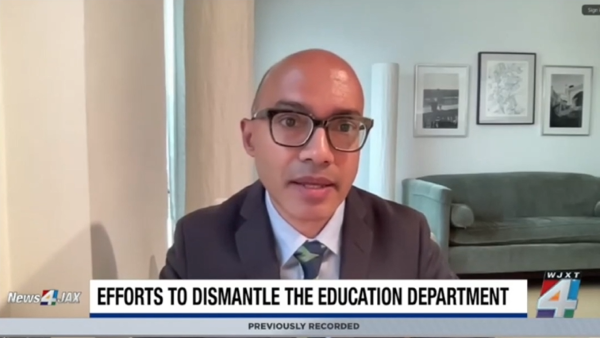
- July 16: Praveen Fernandes appeared on WJXT News4Jax to discuss the Supreme Court’s shadow docket ruling in McMahon v. New York. “TV (WJXT News4Jax): CAC’s Fernandes Discusses the Supreme Court’s Ruling on Dismantling the Department of Education”
- August 5: Praveen Fernandes was quoted as co-chair of the Not Above the Law coalition in Common Dreams’ piece covering the gerrymandering efforts in Texas. “State Labor Federations Team Up to Fight ‘Corrupt, Rigged Redistricting’ by Trump’s GOP”
- July 30: The Brennan Center for Justice featured CAC’s brief in their guide to the amicus support for states who lost vital federal funding in New York v. Trump. “Annotated Guide to the Amicus Briefs in the New York v. Trump Funding Freeze Case”
- July 29: An article from News From The States on the confirmation of Emil Bove to the federal appeals bench quoted Praveen Fernandes as co-chair of the Not Above the Law coalition. “Bove confirmed by US Senate as federal appeals judge, despite misconduct complaints”
- July 15: Common Dreams’ article covering the firing of Joseph Tirrell quoted Praveen Fernandes’s statement as co-chair of the Not Above the Law coalition. “‘More Corruption and Abuse’ on the Way as Bondi Fires DOJ Ethics Chief”
- July 11: Ana Builes and Brian Frazelle published an article in Slate on the Supreme Court’s record of favoring corporate interests. “This Group’s Record in Front of the Roberts Court Is Mind-Boggling”
- July 8: MSNBC quoted CAC’s brief in their article on the Supreme Court’s shadow docket ruling in AFGE v. Trump. “Supreme Court grants Trump appeal to lift order blocking his mass federal worker firings”

Welcome to a New CAC Staff Member, and Farewell to Our 2025 Interns and 2024-25 Kendall Fellow!
This month we are delighted to welcome Ana Lucia Verduzco, who is joining us as our new Operations Manager. Ana Lucia joins us from the American Bar Association’s Center for Human Rights.
July was bittersweet, however, as it also marked the conclusion of summer internships for Alexander Moreno (University of Chicago ’26), Will Cover (Harvard ’27), and Grace Parker (Yale ’27). We also bid farewell to our 2024-25 Kendall Fellow, Margaret Hassel. While we are sad to see them go, we are immensely grateful for all the valuable work they did with us to produce work rooted in the text and history of the Constitution in order to fulfill its progressive promise. We look forward to staying connected and seeing what they accomplish in their future endeavors. See the linked pieces below for their reflections on their time here:
Reflections On My Fellowship by Margaret Hassel
YOUR Support Directly Enables CAC to Fulfill Our Progressive Constitutional Mission
CAC’s work helps defend the rule of law, advance economic justice, promote civil and human rights, and much more. In this critical year, will you support CAC with a gift of $50, $100, $500 or more to fulfill the Constitution’s progressive promise?